
“Step up” is the one cue almost every pet bird owner wants. A bird that calmly steps onto a hand or perch is easier to move around the house, to get back into the cage and to handle at the vet. It also makes daily life less stressful for the bird, because nobody has to chase or grab them.
The catch is that step-up training works best when the bird wants to take part. Pushing a hand at a nervous bird and waiting for it to give in tends to create a bird that bites. The steps below build the behavior gradually, using rewards, and they work for budgies, cockatiels and larger parrots alike.
At a glance: spend time building trust before you ask for anything. Find a small treat your bird loves, teach them to touch a target stick, then use the target to guide them onto a perch and, later, your hand. Keep sessions to a few minutes, stop while your bird is still keen, watch for signs of fear and never punish. Some birds learn in days; others take weeks or months.
Start with trust, not training
A bird that is still unsure of you won’t learn much, because fear crowds everything else out. New birds in particular need time to settle before hands come anywhere near them. For the first stretch, simply be around the cage: sit nearby, talk quietly, read a book, eat your own meals close by.
When your bird stays relaxed with you next to the cage, start offering treats. Drop one into the food dish as you pass. Later, hold one out between the bars and let your bird come to you. The aim at this stage is for your bird to link your presence, and then your hand, with good things.
Find a reward worth working for
Training runs on rewards, and the reward has to be something your bird really wants. Many budgies will work for a short piece of millet spray. Larger parrots often prefer a small piece of nut or a sunflower seed. Keep treats tiny, so your bird can eat them in a second or two and stay interested, and save the favorite one for training only so it keeps its value. Train before a meal rather than straight after one.
Read your bird before every session
Checking your bird’s mood takes a few seconds and prevents most bites. Signals vary between species and individuals, and context always matters, but this is a useful rough guide.
| What you see | What it often means | What to do |
|---|---|---|
| Soft, normal feathers, leaning toward you, watching the treat | Relaxed and interested | Go ahead with a short session |
| Feathers pressed flat and tight, bird looks thin, leans or backs away | Frightened | Stop, step back and try an easier stage another time |
| Open beak aimed at you, lunging, hissing, raised wings | Warning that a bite may come | Remove your hand calmly and end the session |
| Rapid pupil changes (eye pinning) with a stiff body | Excited, sometimes toward aggression | Pause and watch the rest of the body before continuing |
| Foot lifted up toward your hand as if to push it away | “Not now” | Respect it and try again later |
Stage one: teach a target
Target training gives your bird a way to learn without anyone’s hand being close, which is ideal for shy or nippy birds. You need a target (a chopstick or a clean dowel works) and a way to mark the exact moment your bird gets it right. That marker can be a clicker or a short word such as “yes,” said the same way each time and always followed by a treat.
- Hold the target still, a little way from your bird’s beak, through the bars or at an open door.
- The instant your bird touches it with their beak, even out of curiosity, mark it and give a treat.
- Repeat a few times, then stop.
- Over later sessions, hold the target slightly further away so your bird has to take a step or two to reach it.
Once your bird follows the target reliably, you can guide them almost anywhere, including onto a perch.
Stage two: step onto a hand-held perch
A perch held in your hand is a useful middle step, and a lifesaver if your bird ever needs to be moved and isn’t ready for fingers. Hold a perch stick level and steady, just in front of your bird and a little above their feet. Place the target on the far side so your bird has to step onto the perch to reach it. Mark and reward the moment both feet are on.
Add the words “step up” once your bird is doing this smoothly, saying the cue just before they move. Always give the same cue in the same tone.
Stage three: step onto your hand
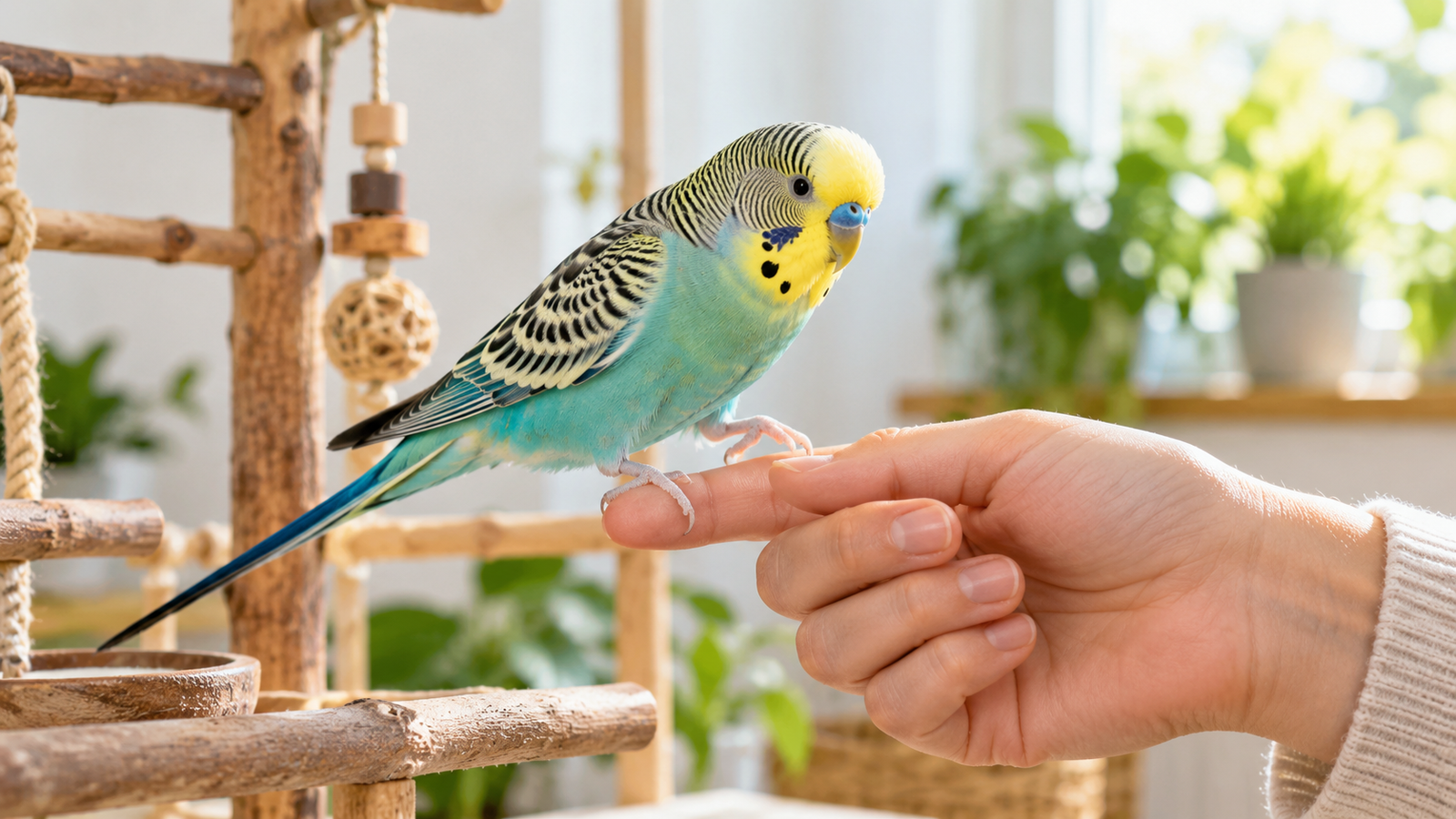
When your bird steps onto the perch stick without hesitation, swap it for your hand. For a budgie or other small bird, offer one straight index finger. For a larger parrot, use the flat edge of your hand or forearm. Hold it level, just in front of the lower chest and slightly above the feet, and keep it completely still.
Many birds reach out and grip with their beak first to test the footing. That’s balance, not biting, and pulling your hand away at that moment can startle them into a real bite. Stay steady, say “step up,” and reward as soon as they are on. Practice stepping down onto a perch or back into the cage too, with a reward each time, so your hand never becomes a signal that fun time is over.
Keep sessions short and upbeat
Birds learn best in short bursts. A few minutes, once or twice a day, is plenty to begin with, and even less for a small bird that loses focus quickly. Always end on a success, even if that means going back to something easy. It’s far better to stop while your bird is still eager than to push until they lose interest or get frustrated.
Why punishment backfires
When a bird bites or refuses, it is telling you something: it’s scared, tired, hormonal or not ready for that step. Punishing the message doesn’t remove the reason for it. Shouting, flicking or tapping the beak, spraying water, shaking the cage or suddenly dropping your hand to unbalance the bird all teach one lesson, which is that people are unpredictable. That usually leads to more fear and more biting, not less.
Instead, if your bird bites, stay as calm and quiet as you can, gently end the session and ask yourself what happened just before. Next time, go back a stage or keep the session shorter. A bird that suddenly starts biting when it didn’t before, or seems unwell, should see an avian vet, because pain and illness can change behavior.
Short training sessions are good mental exercise in their own right, and they pair well with the foraging and play ideas in keeping a budgie happy and mentally stimulated. If your bird is noisy rather than nippy, our piece on why cockatiels scream covers the usual reasons.
Frequently asked questions
How long does it take to teach a bird to step up?
It depends on the bird. A confident, hand-tame bird may learn in a few days, while a nervous or newly adopted bird can take weeks or months. Moving at your bird’s pace is faster in the long run than rushing.
My bird bites when I ask it to step up. What should I do?
Stay calm, avoid reacting loudly and end the session. Go back to target training or a hand-held perch so your hand isn’t within reach, and watch for warning signs such as lunging or an open beak. If biting starts suddenly, have an avian vet check your bird.
Is my bird biting when it grabs my finger with its beak?
Not usually. Many birds use their beak like a third foot to test and grip a new perch before stepping on. Keep your hand still so your bird feels secure.
Can I teach an older bird to step up?
Yes. Birds of any age can learn with reward-based training. Older or rehomed birds may need extra time to trust you first, and target training is often the gentlest place to start.