
Your cat has stopped jumping onto the bed. Or she spends the afternoon under the sofa instead of in her usual sunny spot, and flinches when you stroke her back. None of this looks dramatic, and that is exactly the problem. Cats rarely cry out or limp obviously when they hurt, so the signs your cat is in pain tend to be quiet changes in routine rather than anything that grabs your attention.
Learning to read those small changes means you can get help sooner, whether the cause is a sudden injury or a slow-building condition like arthritis.
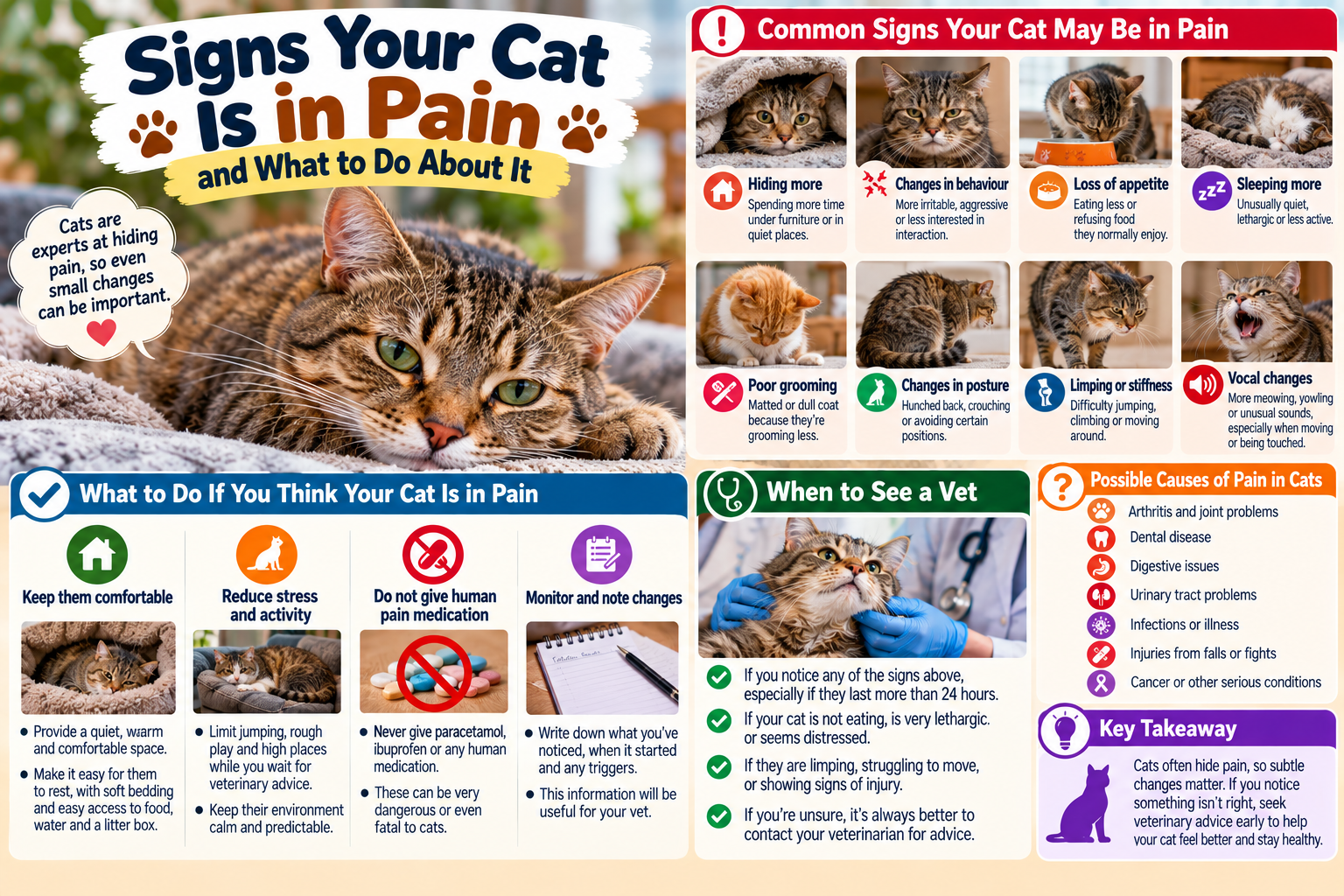
In short: a cat in pain usually shows it through changes in behavior: hiding, grooming less (or licking one spot too much), avoiding jumps, missing the litter box, eating less or lashing out when touched. A hunched posture and a tense, squinting face are also clues. Book a vet visit for any of these, and go immediately for breathing trouble, straining to pee, sudden leg weakness or an injury. Never give your cat human painkillers.
Why cats keep pain to themselves
Cats are small predators that are also hunted by larger animals. In the wild, a cat that looks weak draws attention it doesn’t want, so the instinct is to stay still, stay quiet and carry on as normally as possible. Pet cats haven’t lost the habit.
Purring doesn’t settle the question either. Cats purr when they are content, but many also purr when they are stressed, unwell or hurting. A purring cat can still be a cat in pain.
Everyday behavior that changes when a cat hurts
Pain tends to show up in the things a cat does every day. Some of the most common changes:
- Hiding or withdrawing. Spending more time in cupboards, under beds or in quiet rooms, and less time with the family.
- Grooming changes. A coat that looks greasy, scruffy or matted, often over the lower back and hips where bending hurts. The opposite can happen too: a cat may lick or chew one area over and over, sometimes until the fur thins, when the pain sits underneath it.
- Less jumping and climbing. Hesitating before a jump, choosing lower surfaces, using a chair as a stepping stone or giving up on favorite high perches.
- Litter box trouble. Peeing or pooping just outside the box, often because climbing over the side or squatting is uncomfortable. Other causes are covered in why a cat pees outside the litter box.
- Appetite changes. Eating less, walking away from the bowl, or chewing oddly or on one side, which can point to mouth pain.
- Irritability. Hissing, swatting or biting when picked up or touched in a particular spot, from a cat that used to tolerate it.
- Less activity. Sleeping more, playing less and moving stiffly, especially after a nap.
Posture matters as well. A cat in pain often sits hunched with its back rounded, head low and feet tucked tight underneath, looking tense rather than relaxed.
What a painful face looks like
Researchers at the University of Montreal developed the Feline Grimace Scale, a tool that scores five features of a cat’s face to assess sudden (acute) pain. It has been scientifically validated and is used by veterinary teams, but the ideas behind it are helpful for owners too. Compare your cat’s face now with how it looks on a relaxed day:
- Ears: instead of standing upright and facing forward, they drift apart and rotate outward, or flatten.
- Eyes: the eyes narrow into a squint or look partly closed, even when the cat is awake.
- Muzzle: the area around the mouth and nose looks tense and pulled into a more oval shape rather than soft and rounded.
- Whiskers: rather than curving loosely, they look straight and stiff, and may point forward.
- Head: it hangs below the line of the shoulders or is held tilted down.
One feature alone means little (a cat squinting in the sun is just squinting). A cluster of these changes, alongside a change in behavior, is what should get your attention.
Long-term pain: arthritis in older cats
Acute pain comes on suddenly, from an injury, an infection, a urinary problem or surgery, and the change in your cat is usually quite clear. Chronic pain builds slowly over months, and that makes it easy to miss.
Arthritis (also called degenerative joint disease) is the classic example. In one X-ray study, around 90% of cats aged 12 and over showed signs of joint disease, yet many of those cats are never diagnosed because the signs are mistaken for normal aging. A senior cat that sleeps more, stops using the cat tree, grooms less and has the odd accident beside the litter box may not simply be “getting old.” It may be sore.
Arthritis pain can usually be managed. Your vet can recommend pain relief that is safe for cats, and small home changes help too: a litter box with a low entry, steps or ramps up to favorite spots, soft beds in warm places, and food and water where your cat doesn’t have to jump.
Signs that can’t wait
Urgent: take your cat to a vet straight away, including an emergency clinic out of hours, if your cat is straining in the litter box and passing little or no urine (especially a male cat), is breathing with an open mouth or struggling to breathe, suddenly can’t use its back legs or cries out in severe pain, has been hit by a car or fallen from a height, may have swallowed a poison or medication, or has collapsed.
A cat that has stopped eating also needs a vet promptly, so don’t wait several days to see if the appetite comes back. Cats that go without food can develop a serious liver condition, and a lack of appetite is often the result of pain or illness in the first place.
Never give your cat human painkillers
Cats process many drugs very differently from people and dogs, so the medicine cabinet is the wrong place to start.
Safety note: acetaminophen (paracetamol, also found in many cold and flu remedies) is poisonous to cats, and even a small dose can be deadly. Ibuprofen can cause stomach ulcers and kidney failure in cats. Aspirin and other over-the-counter pain relievers are also dangerous. Do not give any human or dog medication unless your vet has specifically prescribed it for your cat. If your cat has swallowed any of these, contact your vet or an animal poison control service immediately.
Vets have pain medications that are safe for cats when used at the right dose, and they can choose one that suits your cat’s age, kidney health and the cause of the pain.
Helping your vet find the problem
A cat that limps at home may walk perfectly in the exam room, so a few things make the appointment more useful:
- Write down what has changed and roughly when it started.
- Take short videos on your phone of anything odd: the way your cat walks, jumps or sits.
- Note any changes in eating, drinking and the litter box.
- Keep your cat somewhere quiet and warm with food, water and a litter box close by until the visit.
Getting a sore cat to the clinic calmly makes a real difference, and our advice on choosing a cat carrier and making vet visits less stressful can help. Poisoning can also cause sudden pain and illness, so it’s worth knowing the common plants and foods that are poisonous to cats.
Frequently asked questions
Can a cat be in pain and still purr?
Yes. Cats purr when they are relaxed, but many also purr when they are stressed, ill or hurting. Purring on its own doesn’t mean your cat is comfortable, so look at its behavior, posture and face as well.
What can I give my cat for pain at home?
Nothing from your own medicine cabinet. Human painkillers such as acetaminophen (paracetamol) and ibuprofen are toxic to cats. Keep your cat warm, quiet and comfortable, and ask your vet for pain relief that is safe for cats.
How do I know if my older cat has arthritis?
Common signs include jumping less or choosing lower surfaces, stiffness after resting, a scruffy coat over the back and hips, sleeping more and accidents near the litter box. These are often mistaken for normal aging, so ask your vet to check for arthritis.